
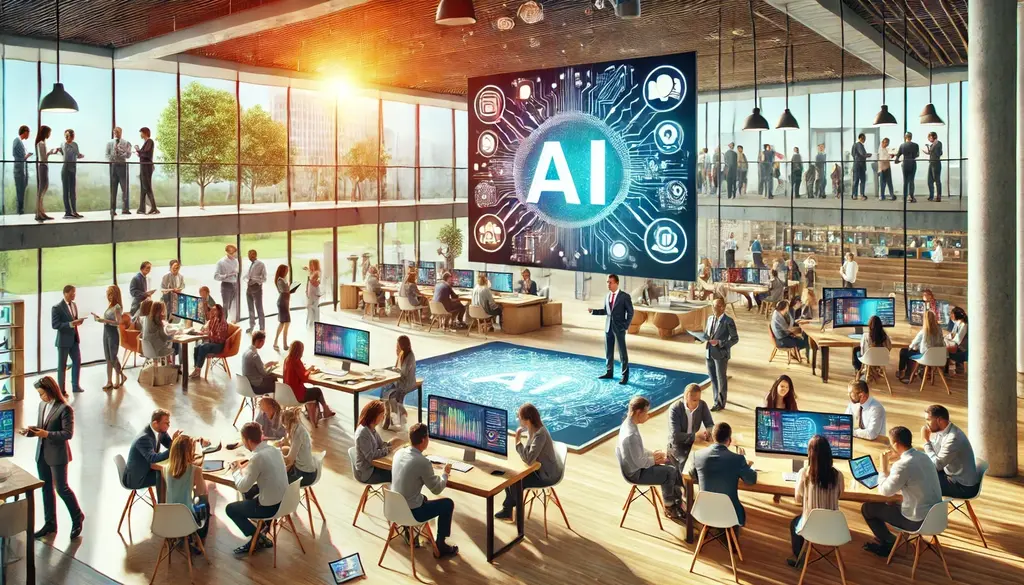
The Future of Team Building: Integrating AI and Psychometrics for Systemic Cohesion
A deep-dive into the convergence of AI-driven analytics and psychometric science, exploring how data-rich team building optimizes organizational resilience and security-mindedness in high-stakes environments.
Audience
General audience
Search intent
Editorial reference
Value
Lead gen n/a · Report reuse n/a
Related products
None
On this page
Legacy Journal
The Future of Team Building: Integrating AI and Psychometrics for Systemic Cohesion
This article turns the future of team building: integrating ai and psychometrics for systemic cohesion into a clearer reader experience with a summary, structure, and actionable framing.
Beyond the Trust Fall: The Science of High-Fidelity Team Dynamics
For decades, "team building" has been relegated to the realm of corporate retreats and "trust falls"—activities often perceived as low-signal and disconnected from the core technical objectives of the organization. However, as we enter the era of AI Security Engineering, the "human layer" of the organization must be treated as a complex, observable, and optimizable system. Traditional methods are no longer sufficient to deliver the lasting impact and systemic resilience required to navigate a stochastic landscape.
At the forefront of this evolution is the integration of advanced psychometrics and Artificial Intelligence (AI). This convergence transforms team building from a social exercise into a "System Profiling" operation, where the cognitive and psychological traits of individual team members are mapped to create a coherent, resilient, and secure organizational architecture.
Psychometrics as System Profiling for Human Capital
Psychometrics is the scientific discipline of measuring mental capacities and processes. When applied to team building, it provides a "base-layer" of data that describes the personality traits, cognitive styles, and behavioral drivers of each individual. This is not about labeling employees; it is about understanding the "variance" in the human system.
By utilizing validated assessments—such as those measuring the Big Five personality traits, cognitive styles, and vocational interests—organizations can generate a detailed profile of their human assets. These profiles serve as the "specifications" for the team, allowing leaders to identify where strengths overlap and where systemic vulnerabilities (such as shared blind spots) exist.
Key Benefits of Psychometric Profiling:
- Enhanced Self-Awareness and Telemetry: Team members gain a deeper understanding of their own strengths and triggers, which is a prerequisite for self-governance in unsupervised environments.
- Cognitive Load Balancing: By understanding individual cognitive styles, leaders can assign tasks that align with a worker's natural processing strengths, reducing burnout and error rates.
- Identification of Authority Nodes: Psychometrics help identify individuals with high "conscientiousness" and "resilience"—traits that are essential for roles that serve as critical security controls.
AI as the Analytical Engine for Team Modeling
While psychometrics provide the raw data, AI provides the analytical power to model how these individual traits will interact within a team dynamic. AI-driven insights take psychometric data and simulate various team configurations to predict performance, conflict triggers, and communication barriers.
This process allows for the creation of dynamic, data-driven workshops that are specifically tailored to the unique dynamics of the team. Instead of a generic curriculum, AI enables "Customized Interventions" that address the specific "noise" within the team's OODA loop (Observe, Orient, Decide, Act).
Key Benefits of AI-Driven Insights:
- Predictive Analytics for Conflict: AI can identify potential "clashes" in personality or communication style before they manifest as workplace friction.
- Actionable Resilience Strategies: AI processes complex data sets to deliver clear, actionable strategies for team improvement that are grounded in statistical probability rather than intuition.
- Real-Time Dynamic Tuning: As the team evolves, AI can update the organizational model, ensuring that team configurations remain optimal as new members are added or objectives shift.
Transforming Team Building through Science and Technology
1. Optimizing Team Dynamics for Security and Innovation
Our workshops leverage these insights to discover and leverage individual strengths, fostering a collaborative environment that is "secure-by-design." By understanding each team member's cognitive style, leaders can better manage and motivate their teams, resulting in improved performance and a more robust security posture. A team that understands its own internal "variance" is better equipped to detect and respond to external "shocks."
2. Eliminating Communication Latency
Effective communication is the "bandwidth" of the human system. AI-driven insights identify communication barriers—such as differences in information processing or emotional response—and provide targeted strategies to overcome them. Through structured exercises, team members learn to communicate with "high fidelity," reducing the misunderstandings that often lead to security lapses or process failures.
3. Data-Driven Conflict Resolution
Conflict is a natural part of any stochastic system, but it must be managed to prevent systemic fragility. Our workshops equip teams with the tools to identify conflict triggers proactively. By promoting empathy through data—showing team members why their colleagues think and behave differently—we transform conflict from a destructive force into a source of innovation and growth.
4. Leveraging Cognitive Diversity for Complex Problem Solving
Diverse thinking styles are a strategic asset. Our workshops emphasize the importance of "Cognitive Diversity," encouraging teams to harness different perspectives to solve complex problems, such as red-teaming an AI model or engineering a zero-trust architecture. This approach not only enhances creativity but also leads to more robust solutions that have been vetted through multiple cognitive lenses.
Real-World Applications in High-Stakes Environments
Incident Response and Red-Teaming
In high-pressure scenarios, such as a cyber incident response, the cohesion of the team is the ultimate security control. Our AI-driven workshops simulate high-stress environments to evaluate how team members interact under pressure. This data is used to optimize the team's "Incident Command" structure, ensuring that the right profiles are in the right roles during a crisis.
Remote and Distributed Team Resilience
Maintaining team cohesion in a decentralized environment is a significant challenge. Our virtual workshops focus on bridging the gap between dispersed nodes. By using AI to map the "social graph" of the remote team, we can identify "isolated nodes" and implement interventions to restore them to the organizational network, ensuring that security culture remains consistent across all locations.
Sales and Leadership Offsites
For high-performance teams, such as those in enterprise sales or executive leadership, alignment of purpose is critical. Our workshops provide personalized insights that help these professionals leverage their strengths to achieve collective goals. By aligning individual "Whys" with the organization's mission, we build a commitment-based culture that is far more resilient than one based on mere compliance.
New Hire Onboarding and Integration
Our onboarding workshops accelerate the integration of new hires by aligning them with the team's cognitive and cultural landscape from day one. New employees receive personalized "Onboarding Manuals" based on their psychometric profiles, helping them navigate their new environment with confidence and precision.
Conclusion: The Future of Organizational Resilience
The integration of AI and psychometrics is setting a new standard for team building. By treating the human layer as a manageable and observable system, HirePurpose.ai provides workshops that are not only impactful but essential for the survival of the modern enterprise. Join the future of team building and transform your workplace into a hub of collaboration, communication, and excellence. Ready to lead your team to new heights? The data-driven path to resilience starts here.
References
[1] Bauer, T. N. (2010). Onboarding new employees: Maximizing success. SHRM Foundation's Effective Practice Guidelines Series. [2] Tett, R. P., Jackson, D. N., & Rothstein, M. (1991). Personality measures as predictors of job performance: A meta-analytic review. Personnel Psychology. [3] Chamorro-Premuzic, T., & Furnham, A. (2010). The Psychology of Personnel Selection. Cambridge University Press. [4] Edmondson, A. C. (1999). Psychological Safety and Learning Behavior in Work Teams. Administrative Science Quarterly.
Related articles
Workforce Science
Remote Work as the New Normal: Leveraging Psychometrics for Distributed Organizational Resilience
8 min read
Psychometrics
Evidence-Based Governance: Why Stochastic Environments Require Reliable Psychometric Baselines
4 min read
Psychometrics
Genetics, Behavioral Baselines, and the Engineering of Secure Talent Pipelines
4 min read