David Wolf · Project Use Case
AI SECURITY · PRODUCT SECURITY · CONFIDENTIAL AI AUTOMATION PLATFORM
Confidential AI Automation Platform
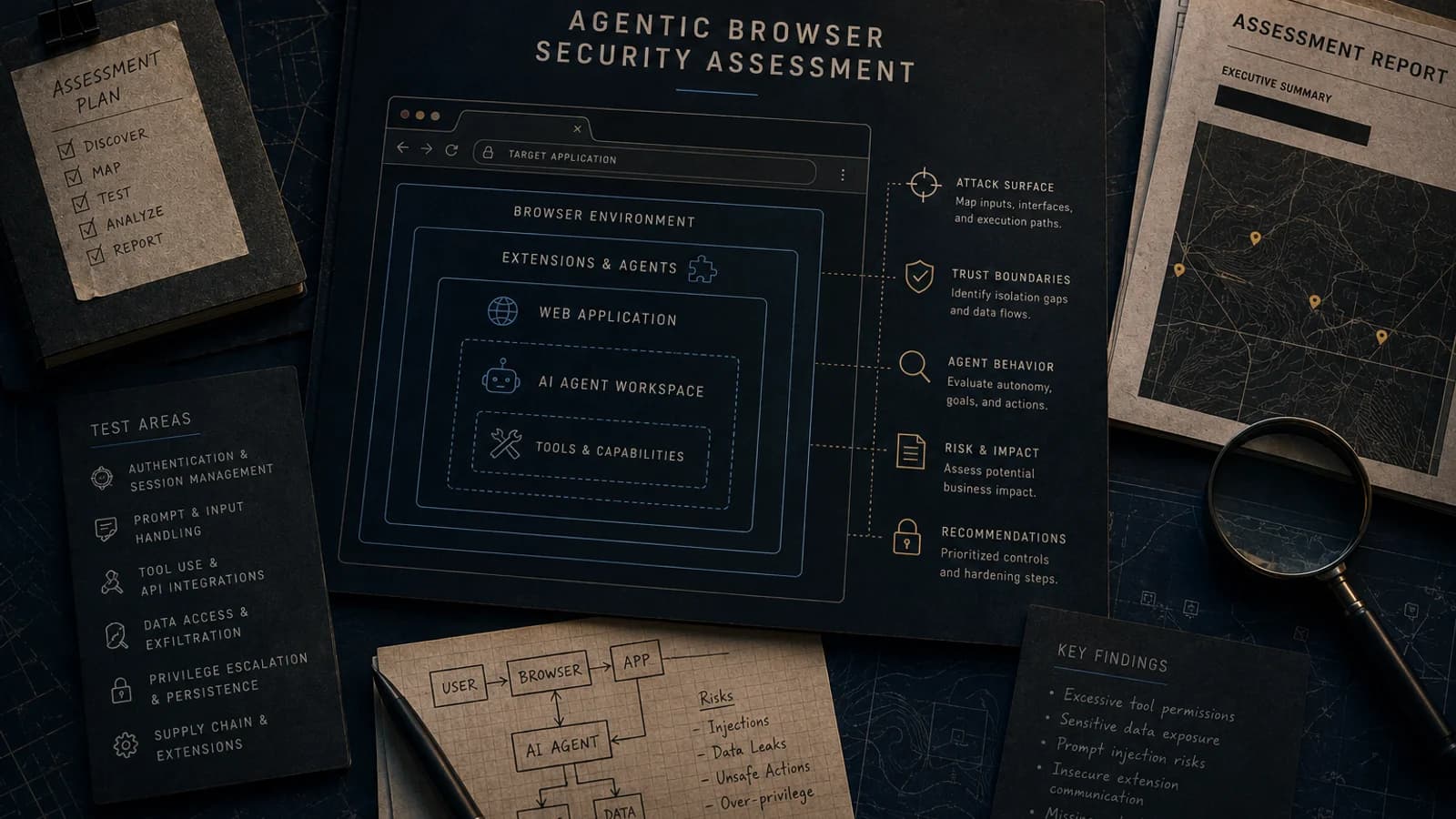
Agentic Browser Security Assessment
A product-security assessment of browser trust boundaries, privileged pages, native bridges, script-injection persistence, credential surfaces, and...
Conducted a deep product-security assessment of browser trust boundaries across native and agentic browser surfaces, including a privacy-focused Windows desktop browser built on WebView2 and .NET. The work covered privileged...
Client
Confidential / Privacy-Focused Desktop Browser
Engagement Type
Security Assessment / Architecture Review
Period
2025–2026
Role
AI Product Security Architect / Browser Security Researcher
Focus Areas
Browser-Native Trust Boundaries, Privileged Internal Pages, WebView2 Security, Native Bridge Exposure
The Research Narrative
Strategic Problem
The central challenge was to evaluate whether trust boundaries were explicit and consistently enforced across WebView2, proprietary internal browser pages, postMessage flows, host-object exposure, persistent...
What David Did
The assessment mapped the browser's sensitive surfaces and modeled how ordinary web content, internal browser pages, native bridges, and command pathways should be isolated. The work...
What Became Clearer
The assessment produced a structured finding model, remediation guidance, and reusable review patterns for browser-native products. The work translates directly to modern AI-agent security...
Consulting Proof
This is evidence of turning messy security telemetry into explainable dashboards, alert-quality improvements, and executive-ready operating views.
The Context
Desktop browsers and browser-like desktop applications increasingly blend web-rendered UI, privileged internal pages, native host objects, credential workflows, and operating-system command surfaces. That makes product security harder than traditional web security because a flaw may cross from renderer logic into native application authority. Agentic workflows compound this further by adding delegated action, persistent session state, and cross-surface tool use.
The Challenge
The central challenge was to evaluate whether trust boundaries were explicit and consistently enforced across WebView2, proprietary internal browser pages, postMessage flows, host-object exposure, persistent script execution, credential-related browser services, native command dispatch, and agentic permission scopes. Each layer had to be evaluated not only alone but as part of a possible chain.
What I Did
The assessment mapped the browser's sensitive surfaces and modeled how ordinary web content, internal browser pages, native bridges, and command pathways should be isolated. The work focused on origin gating, bridge minimization, privileged-page classification, credential-surface protection, and whether script execution or command-dispatch mechanisms could create persistent or higher-privilege effects. A second scope covered agentic workflows and the trust graph they introduce across extension, native, and delegated-action layers.
- •Mapped trust boundaries between ordinary web content, proprietary internal pages, privileged browser UI, native host objects, and command-dispatch surfaces
- •Reviewed WebView2 bridge exposure patterns, including host-object registration and script execution hooks
- •Analyzed origin-gating assumptions around internal-page handling and privileged browser-page routing
- •Modeled postMessage relay risks where cross-origin or internal-page message pathways could bypass intended isolation assumptions
- •Evaluated script-injection persistence mechanisms and the security consequences of initialization scripts executing across future navigation states
- •Assessed credential-surface protection, including whether credential flows depended on brittle URL matching, page classification, or client-side assumptions
- •Reviewed native command launch pathways for unsafe parameter handling, ambiguous authorization, and excessive privilege exposure
- •Modeled browser, extension, native, and automation boundaries as a trust graph for agentic workflow surfaces
The Outcome
The assessment produced a structured finding model, remediation guidance, and reusable review patterns for browser-native products. The work translates directly to modern AI-agent security because agentic desktop automation faces the same question: which web, native, credential, and command surfaces can an untrusted or semi-trusted workflow reach, and how is that reach constrained, observed, and tested?
Research Outcomes
Signal Quality
Improved the trustworthiness of operational security signals
Operational Clarity
Translated complex security data into clearer operating views
Stakeholder Visibility
Made technical risk and status easier to explain
Operational Impact
Turned raw telemetry into actionable security intelligence
Capabilities Demonstrated
Dashboard Development
Operational and executive views
Security Analytics
Signal investigation and event analysis
IAM / Access Control
Identity telemetry and access insights
SIEM Alert Debugging
Noise reduction and signal validation
Executive Reporting
Security data translated for leadership
Telemetry Normalization
Consistent and trusted data
Operational Reporting
Actionable views for security operations
Public-Safe Evidence
Shareable insights without sensitive data
Key Deliverables
- •Anonymized browser product-security assessment report
- •Structured finding taxonomy for privileged browser surfaces
- •Trust-boundary map for web content, internal pages, host objects, and native commands
- •Multi-stage attack-chain model showing composability of boundary weaknesses
- •Remediation guidance for WebView2 host-object exposure and bridge minimization
- •Recommendations for internal-page origin gating and privileged-page isolation
- •Credential-surface protection guidance
- •Native command-dispatch hardening recommendations
Tools & Technologies
Consulting Translation
The reusable pattern is not Disney-specific: normalize fragmented security telemetry, debug low-signal alert behavior, build trusted operating views, and give leadership evidence they can act on without exposing sensitive systems.
Relevant current offers
Portfolio work demonstrates the skills behind these active engagements. Public-safe summaries only — this case study does not imply any ongoing customer relationship or endorsement.
AI Launch Security Review
5–10 business day first engagement. AI surface map, abuse path testing, evidence pack.
AI Product Security Assessment
2–4 week structured review of AI product features, RAG, agents, and data flows.
Start No-Cost Scoping
Not sure which path fits? Get matched to the right engagement before any commitment.