
AI SECURITY ENGINEERING WORKBENCH
The workbench for mapping, attacking, defending, and proving AI systems.
Four integrated instruments for AI security engineering — built to support red-team validation, blue-team hardening, and governance evidence from the same fixture-driven workflow.
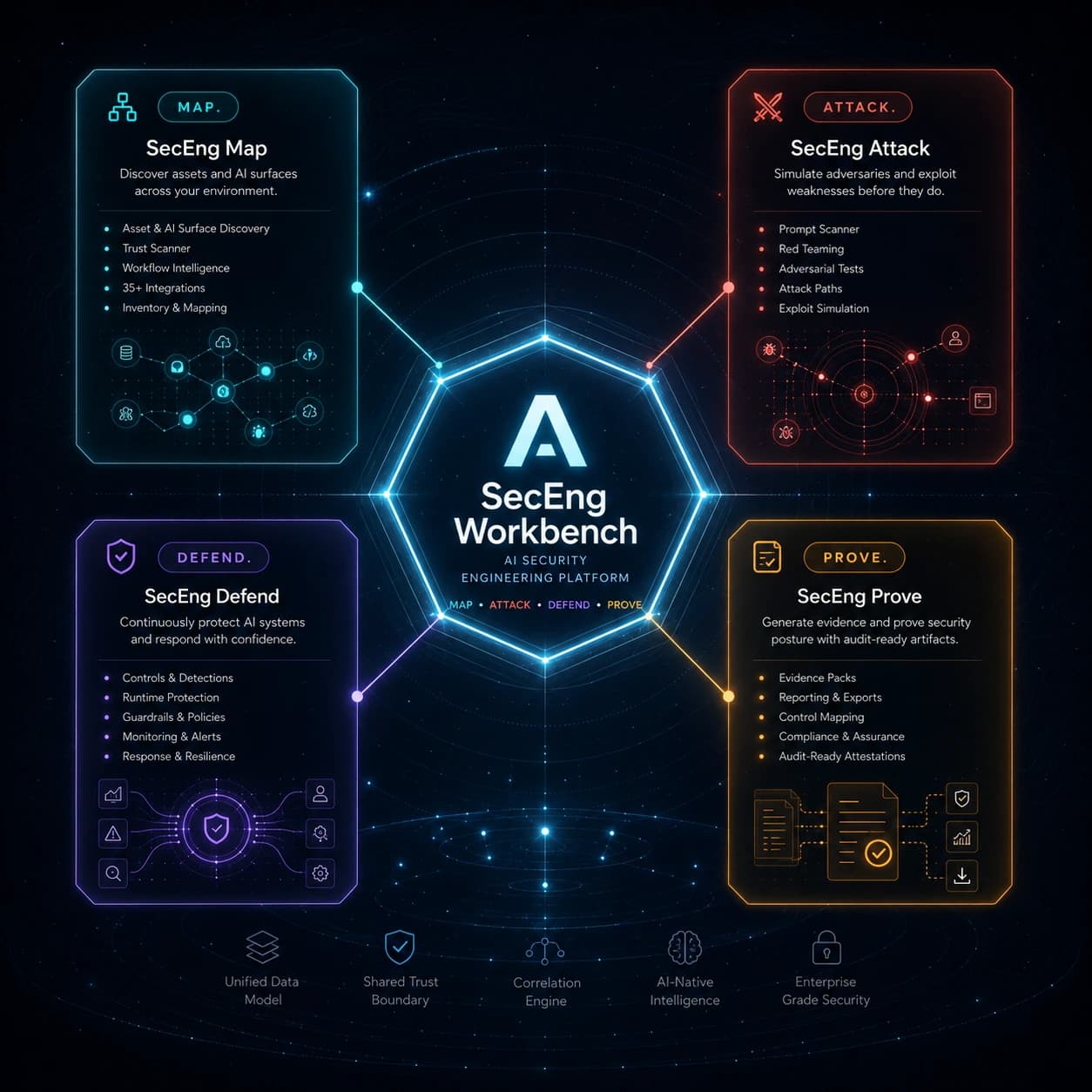
Delivery system
SecEng Workbench is the tool-backed delivery system we use during AI security engagements.
It helps us map AI systems, run adversarial scenarios, harden release paths, and produce evidence buyers, auditors, and security teams can actually use — deployed during assessments, hardening sprints, red-team reviews, and evidence-pack engagements.
Map the AI system
Diagnostic / scoping layer: discover every surface, agent, workflow, tool, retrieval path, data exposure, and trust boundary.
Attack the AI system
Red-team layer: run adversarial tests against prompts, agents, tools, retrieval, authorization, memory, and model behavior.
Defend the AI system
Blue-team layer: turn findings into controls, guardrails, detections, approval gates, telemetry, and release criteria.
Prove the AI system
Governance layer: generate evidence packs, control mappings, framework crosswalks, buyer answers, and audit-ready exports.
One lifecycle. Three service modes. Four instruments.
Map the system. Attack the weak points. Defend the release path. Prove the controls.
Each instrument works alone, but together they support the full path from red-team finding to blue-team fix to governance evidence.
SecEng Map
Find every AI surface, agent, workflow, tool, retrieval path, and data exposure.
SecEng Attack
Run adversarial tests against prompts, agents, tools, retrieval, policies, and model behavior.
SecEng Defend
Turn findings into controls, guardrails, detections, approval gates, and release criteria.
SecEng Prove
Generate evidence packs, control mappings, framework crosswalks, and audit-ready exports.
Live demos — fixture-driven
See each instrument in action.
Every instrument ships with a fixture-driven live demo. Walk through a real run — no setup required.

Where are the trust boundaries?
SecEng Threat Canvas
Service modes
Red-team depth. Blue-team hardening. Governance evidence.
The Workbench keeps the service buckets connected. Red-team work produces reproducible findings. Blue-team work turns them into controls and telemetry. Governance work packages the proof.
Red Team · Map + Attack
We find real attack paths.
- Map AI surfaces before adversaries fingerprint them
- Reproduce prompt injection, jailbreak, RAG, and agent abuse paths as product-security findings
- Build agent abuse chains from real tool compositions
- Poison RAG corpus and validate detection coverage
- Generate regression tests from every confirmed exploit
Blue Team · Defend
We turn findings into controls.
- Design permission boundaries, approval gates, and rollback paths
- Build logging, telemetry, and detection requirements for prompts, retrieval, and tool calls
- Convert exploits into evals, regression tests, and release gates
- Define control owners and operational runbooks
- Track remediation from finding to shipped fix
Governance · Prove
We package evidence buyers and auditors can use.
- Generate evidence bundles for product security, AppSec, GRC, legal, and procurement
- Map findings to OWASP LLM, NIST AI RMF, MITRE ATLAS, ISO 42001, SOC 2, and EU AI Act language
- Create control ownership maps and evidence lifecycle notes
- Produce buyer-ready trust language and questionnaire support
- Deliver board, legal, and governance exports
Standards alignment
Every finding maps to a control framework.
Framework
OWASP LLM Top 10
Application-level LLM risks: prompt injection, insecure output handling, data disclosure, and supply chain.
Framework
NIST AI RMF / GenAI Profile
Risk management language for AI governance: govern, map, measure, manage. GenAI profile adds model-specific controls.
Framework
MITRE ATLAS
Adversarial tactics, techniques, and procedures for AI systems. Maps red-team findings to known adversary behavior.
Framework
ISO 42001
AI management system standard. Evidence packages from every instrument map to ISO 42001 controls for audit readiness.
AI SECURITY ENGINEERING WORKBENCH
Start with a scoped Workbench review.
We'll map your AI surfaces, identify the highest-priority red-team, blue-team, and governance gaps, and show which Workbench instruments apply before you commit to a larger engagement.