
ATG Scorecard
Public trust surface — six dimensions, live in the extension.
95
Public Surface
93
AI Language
91
Legal Clarity
87
Security Trust
89
Consistency
82
Remediation Opportunity
Trust Scanner · ATG Scorecard
aisecurity.llc · public trust surface
The public trust surface is now comprehensive. Legal, AI-governance, security, SDLC, and contract surfaces are all discoverable, linked, and specifically documented. The remaining gap is a formal third-party security certification or attestation.
91
advanced
Public Surface
Whether trust, legal, security, AI, methodology, and contact surfaces are discoverable and coherent.
95% signal
AI Language
Whether AI claims are specific, bounded, and tied to engineering evidence rather than generic positioning.
93% signal
Legal Clarity
Whether privacy, terms, contract, data-processing, and customer-facing boundaries are clear enough to review.
91% signal
Security Trust
Whether public trust artifacts explain controls, evidence, limitations, and escalation paths without oversharing.
87% signal
Consistency
Whether public claims, caveats, service language, and trust artifacts agree across the site.
89% signal
Remediation Opportunity
Whether the public surface makes the next improvement work obvious, scoped, and evidence-backed.
82% signal
Public-signal caveat
Based on public website signals and observed artifacts, not proof of any organization's internal security maturity.
Chrome + VS Code surface
Trust Scanner in the extension
The same ATG scorecard language runs inside the Chrome side panel and the VS Code extension — scan any public page in one click and get the full 6-dimension scorecard in-context.
Observed artifacts · 19 of 21
Top finding
infoFull legal suite is enterprise-reviewable
Keep each document directly linkable from the trust center and contract hub. Enterprise buyers often paste URLs into procurement systems rather than reading inline.
Improvement guidance
Pursue a scoped third-party security attestation
A SOC 2 Type I or equivalent readiness assessment would provide independently verified evidence for the controls already disclosed on the security practices and SDLC pages. Even a scoped readiness letter closes the gap between self-disclosed and verified.
Important caveat
Based on public website signals and observed artifacts, not proof of any organization's internal security maturity.
Detection model
Surface now speaks the same language as the browser snapshot and the shared AI catalog.
Catalog
Versioned AI vendor registry
The shared `savvy-stacks` catalog resolves model providers, SDKs, agent frameworks, vector stores, guardrails, eval harnesses, widgets, and inference runtimes from one canonical registry instead of scattered ad-hoc rules.
Snapshot
Browser runtime signals
Live capture can feed HTML, DOM selectors, script URLs, globals, cookies, local storage, session storage, network requests, headers, URL, visible text, and title into the same analysis path.
Output
Public-safe, annotated results
The output keeps confidence, family summaries, catalog versioning, and structured evidence together so downstream UI, routes, and automation can stay aligned without losing traceability.
Live demo
RAG boundary planning rendered from the shared SecEng Trace fixture.
Shared component
Trace, Chrome, and Surface now use the same RAG lens
The demo keeps the public story honest: the Surface page shows the discovery layer, and the RAG lens shows how those signals turn into boundary plans, testcases, and evidence classification.
Discovery
Surface map
Boundary
Scorecard flow
Output
Harness bundle
Public-safe fixture scope
The lens exposes the artifact names, control paths, and test intent without publishing raw documents, raw answers, or private payloads.
SecEng RAG Test Harness
RAG Boundary Lens
Boundary planning, testcase generation, and evidence classification rendered from the same public-safe trace fixture.
AuthZ pass
Retrieval gates are mostly aligned.
Context leaks
No leak-shaped signals surfaced.
Policy violations
Policy language needs stronger enforcement.
Pipeline snapshot
5Suggested tests
3Controls found
3Affected paths
2Missing boundaries
Priority gaps
Top tests
Harness checks
The lens is public-safe and directional. It uses job-description intelligence and trace fixture signals to show where RAG boundaries need reinforcement, without exposing raw documents or private payloads.
SECENG WORKBENCH
Browser, Repo & IDE AI Discovery
Find every AI surface and vendor before it becomes an attack surface.
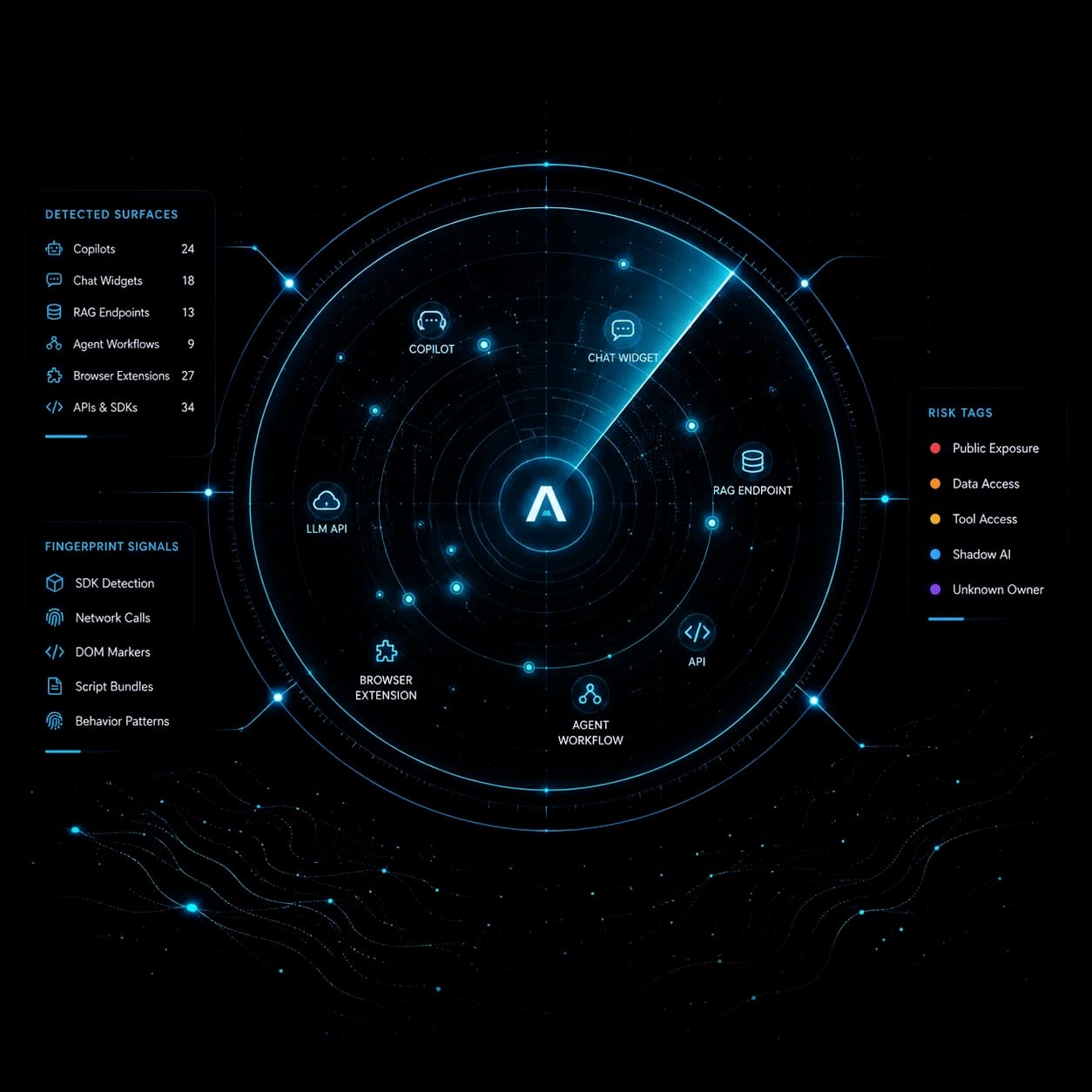
Discover and inventory AI model providers, SDKs, agent frameworks, chat widgets, vector stores, guardrails, eval harnesses, inference runtimes, and shadow AI across your entire product estate — from browser snapshots, repo scans, and IDE extension signals.
Vendor Registry
Resolve model providers, SDKs, agent frameworks, widgets, and runtimes from one canonical catalog.
Browser Snapshot Input
Accept live browser snapshots with HTML, DOM, globals, storage, network, and header signals.
Signal Breadth
Trace DOM markers, script URLs, runtime globals, cookies, URL hints, and API endpoints.
Public-Safe Output
Export confidence, family summary, evidence hits, and catalog version for downstream automation.
50+
AI vendors and runtimes covered in the embedded catalog
10
signal families evaluated per browser snapshot
4
core output fields kept in the analysis payload
1
shared source of truth across WASM, routes, and UI
Core capabilities
What SecEng Surface Scanner does.
AI Vendor & Runtime Detection
Detect OpenAI, Anthropic, Gemini, Bedrock, Azure OpenAI, Cohere, Mistral, xAI, Groq, Together, Fireworks, OpenRouter, Hugging Face, Replicate, NVIDIA NIM, Ollama, vLLM, TGI, Triton, Ray Serve, KServe, BentoML, and Cloudflare Workers AI from the same catalog.
SDK, Widget, and Framework Classification
Classify LangChain, LangGraph, LlamaIndex, Semantic Kernel, AutoGen, CrewAI, Haystack, Dify, Flowise, Botpress, Voiceflow, Intercom Fin, Botsonic, Ada, Crisp, Zendesk AI, Gorgias, and similar embedded surfaces.
Browser Runtime Fingerprinting
Use HTML, DOM, globals, cookies, storage, URL, network, and script-path heuristics to find AI surfaces that do not self-report cleanly.
Snapshot-Native Analysis
Accept live browser snapshots from crawlers or extension-based capture and return ai_matches, ai_family_summary, snapshot_summary, and catalog_version in one payload.
Public-Safe Inventory Export
Export a structured inventory with confidence, family labels, evidence hits, public_safe flags, and canonical vendor metadata for downstream reporting.
Live Scan Harness
Use the browser harness and snapshot route to iterate against real pages, DOM captures, and local fixtures without forking the detection logic.
Evidence & signals
What you get out of the box.
Detected Families
- Model Providers
- SDKs & Frameworks
- Vector Databases
- Guardrails & Evals
- Widgets & Assistants
- Inference Runtimes
Signal Sources
- HTML
- Scripts
- DOM
- Globals
- Headers
- Cookies
- Storage
- URLs
- Network
Output Fields
- ai_matches
- ai_family_summary
- catalog_version
- snapshot_summary
- public_safe
- confidence
Red team + Blue team
Built for both sides of the security equation.
Red Team Use
- Find hidden attack surface: undocumented AI endpoints, embedded widgets, runtime globals, and SDK bundles
- Identify shadow AI providers and tool calls before they spread across the product estate
- Trace browser-level signals that a vendor never documented but still ships in production
Blue Team Use
- Produce an AI asset register with vendor, family, confidence, public-safe flag, and evidence hits
- Generate evidence bundles for product security, governance, and executive reporting
- Keep the WASM, route, and browser harness aligned to one shared catalog and schema
AI SECURITY ENGINEERING WORKBENCH
Ready to put SecEng Surface Scanner to work?
Scope a Workbench-backed review — we'll map the AI surfaces, identify the highest-priority gaps, and give you clear findings before any larger commitment.
Also in the Workbench
WHAT DID IT ACTUALLY DO?
SecEng Runtime Proxy
MITM Capture, Replay & Runtime Evidence
HOW CAN IT FAIL UNDER ATTACK?
SecEng Adversarial Range
AI Red-Team Scenario Harness
WHAT CAN AGENTS ACTUALLY DO?
SecEng Authority Graph
Agent Authority & Approval-Path Analysis
WAS RETRIEVAL AUTHORIZED?
SecEng RAG Test Harness
Retrieval & Context Security Test Harness